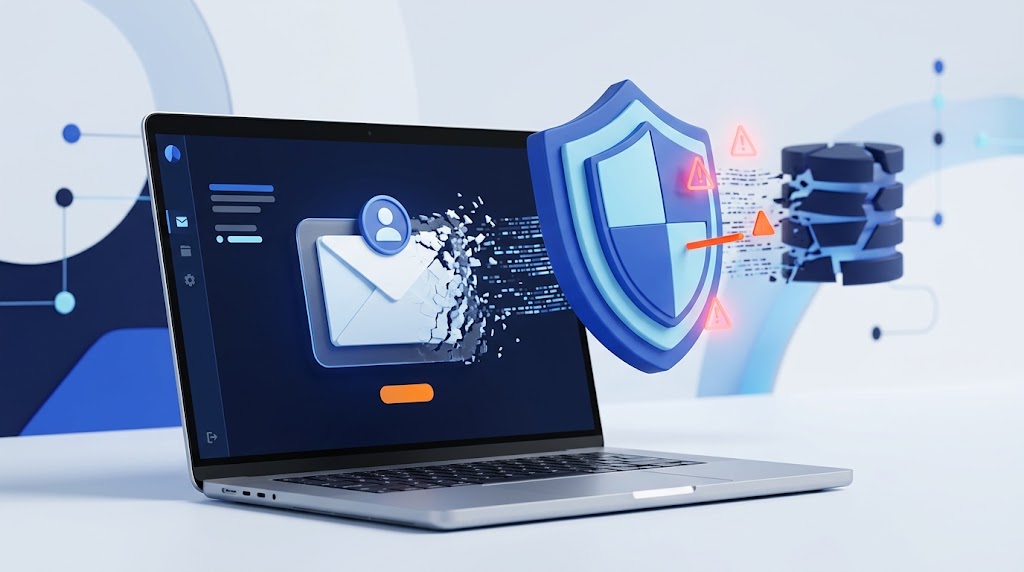
Data breaches are not rare events anymore — they are a background fact of using the internet. Barely a month goes by without another company announcing that a database of usernames, emails, and passwords has been exposed. You cannot personally stop a company from getting breached, and you cannot control how carefully they store your information once you have handed it over. What you can control is how much of your real identity is sitting inside any single database in the first place, and that is where disposable email earns its place in a basic privacy routine.
Why your email address matters more than it seems
An email address is often treated as a throwaway detail, but it functions as a primary key across the internet. It is how accounts are created, how passwords are reset, and — critically for anyone assembling stolen data — how records from different breaches get linked together. If the same email address shows up in a shopping site breach, a forum breach, and a fitness app breach, all three of those exposed records can be joined into a single, more complete profile of one person.
This is exactly why credential-stuffing attacks work: attackers take a batch of email-and-password pairs from one breach and simply try them against other popular sites, betting that people reuse passwords. Even without password reuse, a shared email address alone is enough to help build a more detailed picture of someone's habits, purchases, and accounts.
How disposable email interrupts that pattern
When you use a temporary address for a low-stakes sign-up — a discount code, a one-time download, a forum account you will barely touch — you are removing the "shared key" that would otherwise connect that record to everything else tied to your real email. If that particular company is breached six months later, the exposed record points to an inbox that no longer exists and has never existed anywhere else. There is nothing to link, nothing to correlate, and nothing that leads back to your real accounts.
This does not prevent every breach-related risk. If you used the same password on that site as you do elsewhere, or you gave your real name and address in other fields, some exposure still exists. But cutting the email address out of the equation removes one of the most commonly used connective threads that data brokers, spammers, and attackers rely on.
The sign-ups that carry the most risk
- Small or newer websites without a strong track record on security practices
- One-time downloads — ebooks, whitepapers, templates — from unfamiliar sources
- Forums, comment sections, or contest entries you expect to use once
- Free trials for tools you are only evaluating, not planning to keep
- Any site that asks for an email address purely to "unlock" content you could otherwise access freely
These are the exact situations where a disposable address adds the most protection, because the sign-up itself is low-value to you but the sites collecting the data are often smaller operations with less mature security practices than a major bank or well-funded tech company.
What disposable email does not protect against
It is worth being clear-eyed about the limits. A disposable address will not protect you if you reuse the same password across your important accounts — that vulnerability exists independently of which email address you used to sign up. It will not protect financial or medical accounts, because those require a persistent, recoverable address by design. And it will not stop a breach at a company where you are already a long-term customer using your real email, since the address was already tied to you before the breach occurred.
Disposable email is a preventive measure for future low-stakes sign-ups, not a retroactive fix for accounts you have already created with your real address. For those, the standard advice still applies: use unique passwords, enable two-factor authentication where available, and check breach-notification services periodically.
Building a simple habit around it
The easiest way to make this practical is to ask one question before typing your email into any form: "Will I need this account to work again in six months?" If the honest answer is no — you just want the coupon, the file, or the one-time access — a disposable address is almost always the better choice. If the answer is yes, because the account matters for something ongoing, your real address (paired with a strong, unique password) is the right call.
Over a year, this single habit meaningfully reduces how many places your real email address exists. Fewer places holding your data means fewer places that can leak it, and fewer breach notifications landing in your inbox telling you your information was exposed somewhere you barely remember signing up for.
What happens after a breach either way
If a site where you used a disposable address is breached, the practical impact on you is close to zero — the address has already expired, the inbox no longer exists, and there is no real account of yours to compromise further. If a site where you used your real email is breached, the standard response applies: change the password on that account and anywhere else you reused it, watch for phishing attempts referencing the breach, and consider a password manager if you have not already adopted one.
The difference in outcome between those two scenarios is the entire argument for using disposable addresses on sign-ups that do not need to last.
How breach data actually gets used
It helps to understand what happens to information after a breach occurs, since this shapes why cutting off the email-address link matters so much. Stolen databases are frequently compiled, combined with other leaked datasets, and sold or traded on forums dedicated to that purpose. Attackers assembling these combined datasets are specifically looking for shared identifiers — email addresses chief among them — to merge fragmented records from different breaches into a single, more valuable profile that includes more context about a person than any single breach would reveal on its own.
A record tied to a disposable address that expired months earlier is effectively a dead end for this kind of correlation. It cannot be merged with anything else, because it was never linked to anything else to begin with. This is a small but meaningful form of protection that costs nothing and requires no ongoing effort beyond the initial habit of choosing a temporary address for low-stakes sign-ups.
The economics of breach data trading
It is worth understanding briefly why this correlation matters so much economically to the people trading stolen data. A single breach with an email address and nothing else is worth relatively little on its own. A profile built by merging that email address across five or six different breaches — revealing shopping habits, financial services used, physical addresses, and more — is considerably more valuable, because it enables more targeted phishing, more convincing social engineering, and more effective identity theft attempts. Every sign-up you route through a disposable address is one fewer data point available for that kind of merging, which quietly reduces the value of any breach involving your information to whoever might eventually obtain it.
Checking whether your real email has already been exposed
For addresses you have already used across various sign-ups over the years, several reputable breach-notification services allow you to check whether a given email address has appeared in a known data breach. Running your real, long-term email through one of these checks periodically is a reasonable complement to using disposable addresses going forward — it addresses the exposure that has already happened, while disposable email addresses handle prevention for anything new.
A layered approach, not a single fix
Disposable email works best as one layer in a broader set of habits rather than a standalone solution. Combining it with a password manager, unique passwords per site, two-factor authentication on accounts that support it, and periodic checks of known breach databases gives you a reasonably strong baseline without requiring constant vigilance. Disposable email specifically handles the "how many places have my real email address" problem — it is not meant to replace the other layers, just to reduce how much damage any single breach can do.
Frequently asked questions
Does a disposable email address protect my password if I reuse it?
No. Password reuse is a separate risk that exists regardless of which email address is tied to the account. Unique passwords per site remain essential.
Should I use disposable email for online banking or healthcare portals?
No. These accounts require long-term recoverability, and a disposable address will expire and lock you out permanently. Use your real, secured email for anything you need to access again later.
Can a disposable email address itself be part of a data breach?
In theory, if a provider's own systems were compromised while a mailbox was still active, messages during that brief window could be exposed. This risk is limited by the short lifespan of the inbox itself, unlike a permanent account that remains exposed indefinitely.