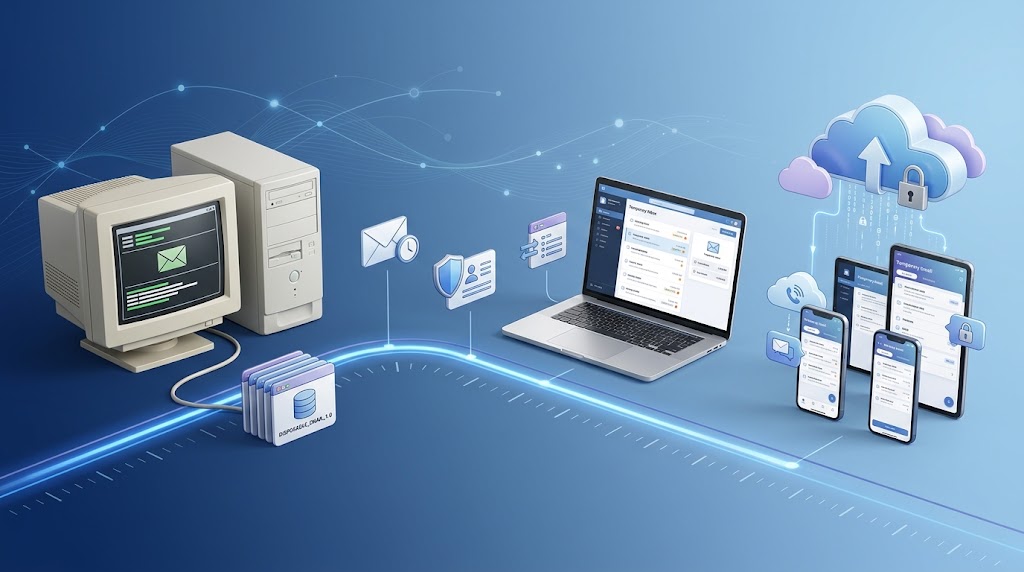
Temporary email feels like a modern convenience, but the underlying idea is nearly as old as spam itself. As soon as email became the default way to sign up for anything online, people started looking for ways to hand over an address without paying the long-term cost of joining another mailing list. What began as a niche trick used mostly by developers and early internet forum communities has grown into a mainstream privacy habit used by millions of people every day.
The early days of email overload
In the late 1990s and early 2000s, as more of everyday life moved online, email addresses quickly became the default identifier for creating an account almost anywhere. Forums, download sites, and early e-commerce stores all asked for an email address, usually with little transparency about what would happen to it afterward. Spam volume grew rapidly during this period, driven partly by harvested addresses from public sign-up forms and partly by lists sold between marketing companies.
Technically savvy users were among the first to notice the pattern: any sign-up form was a potential source of future spam, and there was no reliable way to know in advance which sites would respect that boundary and which would not. This gave rise to some of the earliest workarounds, including manually created "junk" email accounts on free webmail providers, used specifically for sign-ups the person did not fully trust.
The first dedicated disposable email services
By the mid-2000s, dedicated disposable email services began to appear, automating what had previously required manually creating and abandoning throwaway accounts. These early services offered a simple proposition: visit a page, receive a working email address instantly, and use it for whatever sign-up prompted the visit. There was no need to remember a password or maintain the account afterward, since it was designed to be abandoned by default.
These early tools were popular primarily within tech-savvy communities — developers testing signup flows, forum users wary of harvested addresses, and people trying to avoid an increasingly aggressive wave of marketing email. Awareness outside these circles remained limited for several years, largely because the concept required first understanding just how much spam a single sign-up could generate.
Growing mainstream awareness of email privacy
Public understanding of email privacy shifted substantially over the following decade, driven by a combination of factors: increasingly frequent and high-profile data breaches, growing awareness of how data brokers assemble and sell personal profiles, and broader public discussion about digital privacy in general. As people became more conscious of how their email address functioned as a tracking and correlation tool across different services, disposable email moved from a niche developer trick toward a more general audience.
Browser extensions, mobile apps, and simplified web interfaces made disposable email accessible to people with no particular technical background. What once required understanding mail servers and manually managing throwaway accounts became a matter of visiting a single page and copying an address — no different in effort from copying a phone number.
Regulation and the changing legal landscape
The introduction of major privacy regulations, including Europe's General Data Protection Regulation and various data protection laws that followed in other regions, changed the incentives around personal data collection more broadly. Companies became more cautious about how they collected and retained email addresses, and public awareness of "the right to be forgotten" and data minimization principles increased alongside it.
This regulatory shift did not eliminate the value of disposable email — if anything, it reinforced the underlying logic. If companies are expected to justify why they retain personal data, using a disposable address for interactions that do not require a lasting relationship aligns naturally with that same principle: only share what is actually needed, for as long as it is actually needed.
How the technology matured
Early disposable email services were often simple and occasionally unreliable, with inboxes that were slow to update or interfaces that felt like an afterthought bolted onto a basic mail server. Over time, the technology matured considerably. Modern services generate addresses instantly, refresh inboxes automatically without manual reloading, and present incoming messages in a clean, readable interface rather than raw plain text.
Reliability also improved as providers adopted more robust infrastructure for handling incoming mail, filtering out malformed messages, and managing the churn of constantly creating and destroying temporary mailboxes at scale. What used to be a slightly clunky workaround became, for many users, simply another browser tab they open without a second thought.
From developer tool to everyday habit
Perhaps the most significant shift in the history of temporary email is who uses it. What started as a tool primarily for developers testing signup forms and privacy-conscious early adopters has become a routine part of how ordinary people interact with the parts of the internet that ask for too much in exchange for too little. Claiming a coupon code, downloading a resource, or trying a free tool without committing to a mailing list is now a mainstream expectation rather than a niche workaround.
The role of spam filters in shaping the industry
The evolution of temporary email cannot be separated from the parallel evolution of spam filtering technology. As webmail providers built increasingly sophisticated filters to catch unwanted mail automatically, some of the original motivation for disposable addresses — avoiding an overwhelming volume of spam in a primary inbox — shifted somewhat. However, spam filters primarily address volume and obvious malicious content; they do less to prevent a person's email address from being sold, shared, or correlated across databases in the first place. Disposable email addresses continued to serve that second purpose even as filters improved at handling the first.
Community-driven growth before mainstream adoption
Long before dedicated marketing or widespread news coverage brought disposable email to a general audience, its growth was largely community-driven. Recommendations circulated informally on forums, in comment threads, and through word of mouth among people who had grown frustrated with spam from a particular category of sign-up. This organic, grassroots pattern of adoption is part of why the tool feels so functional and stripped-down even today — it grew out of practical necessity rather than a coordinated product launch.
Where temporary email fits today
Modern services like VanishBox represent the current stage of this evolution: instant address generation, no account creation required, automatically refreshing inboxes, and a clean interface that treats the disposable inbox as a first-class tool rather than a hacked-together side project. The core idea has not changed since the earliest throwaway accounts — a short-lived address for a short-lived need — but the experience of using one has become dramatically simpler.
Looking forward, the trajectory seems likely to continue in the same direction: less friction, faster address generation, and tighter integration into the everyday flow of signing up for things online. The underlying motivation — avoiding unnecessary long-term exposure of a personal identifier for a one-time interaction — has remained constant even as the tools built around it have improved.
Lessons from two decades of disposable email
Looking back across the full arc of this history, a few patterns stand out. First, the core need — avoiding unnecessary long-term exposure of a personal email address for a short-term interaction — has remained remarkably stable even as the specific threats have shifted from basic spam to more sophisticated data broker networks and large-scale breaches. Second, the tools built to address that need have consistently trended toward simplicity: fewer steps, less setup, and faster access, rather than adding complexity over time. Third, adoption has moved steadily from a narrow technical audience toward a broad, mainstream one, tracking closely with general public awareness of digital privacy issues.
None of this suggests the underlying idea was ever complicated. It has always been a fairly simple proposition — a short-lived address for a short-lived need — and the twenty-plus years of history behind it mostly reflect steady refinement of how easily that simple idea can be delivered, rather than any fundamental change in what it is trying to accomplish.
What the future of temporary email might look like
As identity verification requirements become stricter on some platforms, and as data protection regulation continues to expand into new regions, disposable email will likely continue adapting alongside those pressures rather than disappearing. Some analysts and industry observers expect increased integration between temporary email tools and broader identity-masking services, such as virtual phone numbers and masked payment cards, giving users a more complete toolkit for handling short-term interactions without exposing any single piece of real personal information. Whether or not that broader integration becomes standard, the core function of temporary email — a short-lived address for a short-lived need — appears likely to remain relevant for as long as websites continue asking for an email address before granting access to something.
Frequently asked questions
When did disposable email services first appear?
Dedicated disposable email services began appearing in the mid-2000s, automating a practice that tech-savvy users had already been doing manually with throwaway webmail accounts.
Why did disposable email become more popular over time?
Growing awareness of data breaches, data brokers, and general privacy concerns pushed more people to look for ways to limit how widely their real email address was shared.
How has the technology changed since the early services?
Modern disposable email services are faster, more reliable, and present a cleaner interface than early tools, with instant address generation and automatically refreshing inboxes.