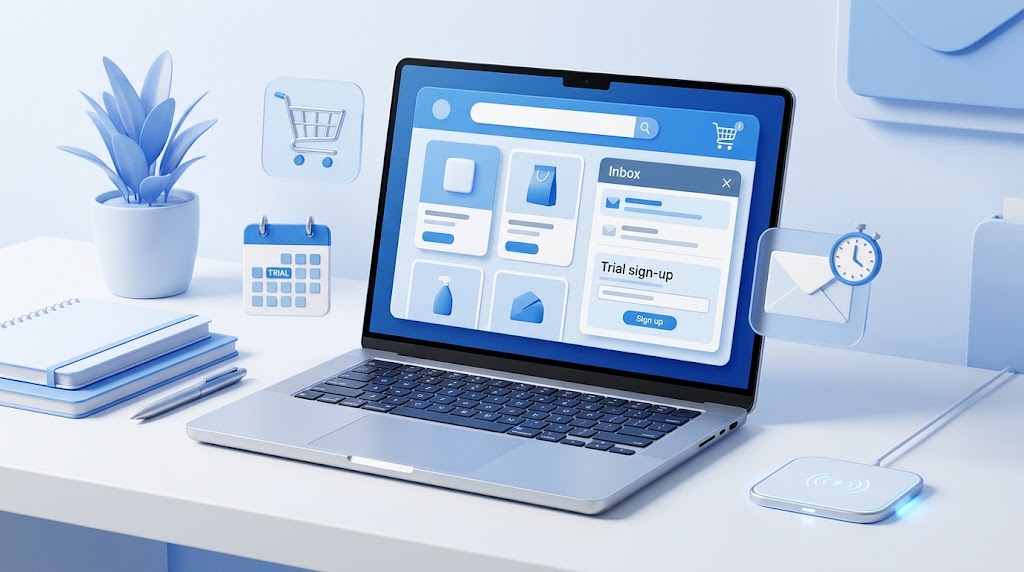
Online shopping and free trials share a common pattern: a company wants your email address before it gives you anything, whether that is a discount code, early access to a sale, or a two-week trial of a paid tool. In exchange for a small, one-time benefit, you are often signing up for months or years of promotional email afterward. Disposable email lets you take the benefit without accepting the long tail of marketing that usually comes with it.
The pattern behind "sign up for 10% off"
Almost every e-commerce site now gates a first-time discount behind an email address. The math behind this is straightforward from the retailer's side: the discount is a small cost in exchange for a long-term marketing asset — your email address — that they can use indefinitely. Once you are on the list, you will typically receive regular promotional emails, seasonal sales, cart-abandonment reminders, and re-engagement campaigns for as long as you remain subscribed.
If you are shopping at a store you plan to use again and again, joining that list with your real address might genuinely be worth it — you will actually want to hear about sales later. But if you are making a single purchase, or just browsing and want the discount code without the ongoing relationship, a disposable address gets you the code without the years of email that would otherwise follow.
Free trials and the renewal problem
Free trials work on a similar mechanic but with a sharper edge. Many trial sign-ups require an email address (and sometimes a card) up front, and the company is counting on a percentage of users forgetting to cancel before the trial converts into a paid subscription. Losing track of a trial's end date is a common and expensive mistake, especially for tools you were only evaluating out of curiosity.
Using a disposable address for the email-only portion of a trial sign-up (where no payment method is required) means that even if you forget you ever signed up, there is no ongoing account tied to your real inbox nagging you to convert, and no long-term record connecting the trial back to your identity. For trials that do require a card, a disposable address does not remove the billing risk, but it does prevent the accompanying flood of "don't forget to upgrade" emails from reaching your main inbox.
Situations where this approach works well
- Claiming a first-time discount code at a store you are unlikely to shop at again
- Signing up for a free trial of software you are only testing, with no card required
- Entering an online contest or giveaway that requires an email to participate
- Downloading a size chart, buying guide, or lookbook that is gated behind an email field
- Registering for early access to a product drop you plan to check once
Situations where you should use your real email instead
Not every shopping or trial scenario is a good fit for a disposable address. If you are placing an actual order, you generally need a working email for shipping confirmations, delivery updates, and — most importantly — customer service and returns. An expired disposable address that can no longer receive a return authorization or a refund confirmation can turn a minor issue into a real headache.
Similarly, if a free trial is for a tool you are seriously considering paying for long-term, using your real email from the start avoids the awkwardness of losing access to your trial data, saved settings, or history when the disposable address expires. In both cases, the deciding factor is the same one that applies elsewhere: will you need this account to still be reachable later?
A practical way to decide
Before entering an email address into a shopping or trial sign-up, ask two quick questions. First, am I actually placing an order or starting a subscription I intend to keep, or am I just unlocking a one-time perk? Second, will I need to receive follow-up communication — a shipping update, a receipt, a renewal notice — that matters to me? If the answers point toward a real, ongoing relationship, use your real address. If they point toward a single, disposable interaction, a temporary inbox is the better fit.
Keeping your inbox usable
The cumulative effect of using disposable addresses for one-time shopping perks and trial sign-ups is a noticeably cleaner inbox over time. Promotional email from stores you visited once, trial reminder emails for tools you stopped using months ago, and "we miss you" campaigns from services you barely remember joining are some of the most common sources of inbox clutter. Redirecting those specific sign-ups to a temporary address prevents that clutter from accumulating in the first place, rather than requiring you to unsubscribe from dozens of lists later.
Comparing multiple retailers or tools before deciding
A particularly useful application of this approach comes up when comparing several competing stores or software tools before committing to one. Signing up for accounts, trials, or mailing lists at three or four competing options with your real email means fielding marketing and re-engagement campaigns from every option you ultimately did not choose. Using a disposable address during this comparison phase, and only switching to your real email for the option you settle on, keeps the evaluation process from generating long-term inbox clutter regardless of how many alternatives you looked at along the way.
Loyalty programs and points-based systems
Loyalty and rewards programs deserve a slightly different consideration than a simple one-time discount. If you shop at a particular retailer regularly and plan to accumulate points or rewards over time, that is exactly the kind of ongoing relationship where your real email address makes more sense, since you will likely need to recover the account, track your points balance, or receive rewards notifications well into the future. Using a disposable address for a loyalty program you intend to use long-term risks losing access to accumulated rewards once the address expires.
Seasonal sales and limited-time promotions
Seasonal promotions, such as holiday sales or flash discount events, are often structured as one-time email captures explicitly designed to build a mailing list for the following year's campaigns. If you are shopping a single seasonal sale without intending to become a repeat customer, this is a clear case where a disposable address captures the immediate benefit — the discount code or early access — without signing up for the following eleven months of promotional email leading up to the next similar event.
What to watch for at checkout
Some retailers specifically block known disposable-mail domains at checkout, particularly larger platforms with fraud-prevention systems in place. If a disposable address is rejected during an actual purchase, that is a reasonable signal to use your real email for that transaction rather than trying to work around the block — an order confirmation and the ability to resolve a shipping issue later are worth more than avoiding one promotional list.
Subscription boxes and recurring purchase programs
Subscription boxes and recurring purchase programs sit somewhere between a one-time purchase and a long-term account, and they deserve a moment of thought before deciding which type of email address to use. If you are only trying a single box as a gift or a curiosity with no intention of continuing the subscription, a disposable address avoids a long tail of "don't miss next month's box" reminders after you have already decided not to continue. If you genuinely plan to stay subscribed, your real email becomes important for billing notifications, shipping updates, and the ability to pause or cancel the subscription later without friction.
Group deals and referral-based discounts
Referral programs and group-buying deals often require an email address to track who referred whom, or to confirm that a minimum number of participants joined before a discount unlocks. Because these are typically single-event promotions rather than ongoing accounts, they fit the same pattern as other one-time discount scenarios: a disposable address lets you participate in the specific deal without becoming a permanent contact for that platform's future group offers.
Digital nomad and travel sign-ups
Travelers frequently encounter one-time sign-up requirements specific to a trip: a local tourism board's newsletter offering a discount on an attraction, a car rental comparison site, or a short-term vacation rental platform's inquiry form. These sign-ups are tied to a specific trip and rarely warrant a permanent spot on your regular email list once the travel dates have passed. A disposable address handles these travel-specific, time-boxed interactions cleanly, letting you access the local discount or booking confirmation without accumulating destination-specific marketing email for locations you have already left.
Frequently asked questions
Can I still receive my discount code with a disposable email?
In most cases, yes. Discount codes are typically sent immediately after sign-up, well within the active window of a temporary inbox, so you can retrieve the code right away.
What happens if I use a disposable address and then actually place an order?
Any shipping confirmations, delivery updates, or support responses sent after the address expires will not reach you. If you are completing a real purchase, switch to your real email for that transaction.
Do free trial sites detect disposable email addresses?
Some do, particularly ones with sophisticated fraud prevention. If a sign-up is rejected, it is usually because the platform maintains a block list of known temporary-mail domains.