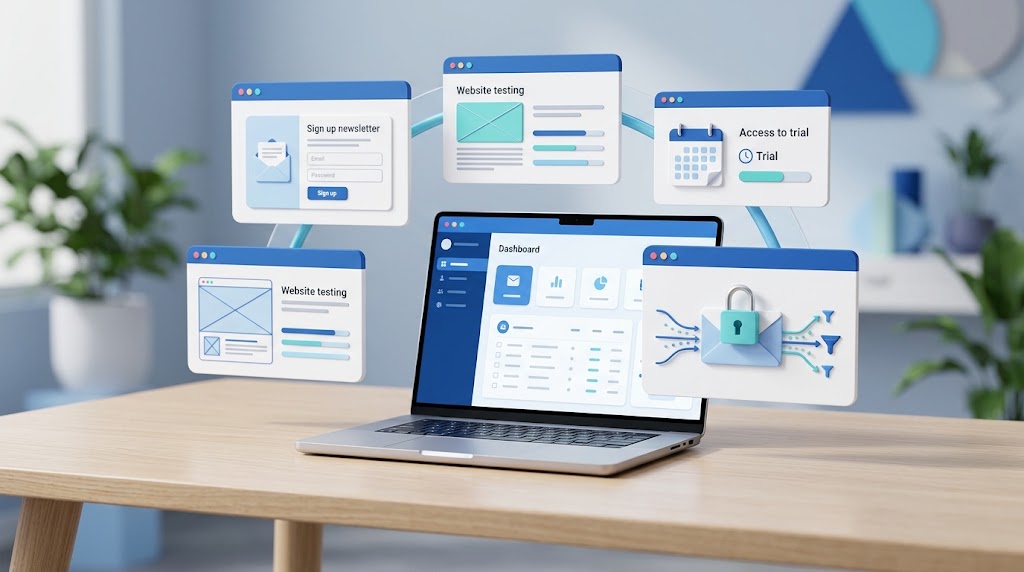
Disposable email tends to get discussed in fairly abstract privacy terms, but the actual reasons people reach for it day to day are almost all specific and practical. Below are seven of the most common, everyday situations where a temporary inbox genuinely helps — not as a theoretical privacy measure, but as a small tool that saves time and keeps your real inbox cleaner.
1. Claiming a one-time discount code
Online stores frequently gate a first-time discount behind an email signup, whether that is 10% off, free shipping, or early access to a sale. If you are making a single purchase and have no plans to become a regular customer, a disposable address lets you claim the discount without joining a mailing list you will need to unsubscribe from later. Open a temporary inbox, use the address at checkout, retrieve the code, and move on — the address does not need to exist a moment past that.
2. Downloading a gated resource
Ebooks, whitepapers, templates, and buying guides are commonly locked behind an email field, even when the content itself is freely promotional material rather than something requiring an ongoing relationship. A disposable address gets you past the gate immediately, without adding another sender to your regular newsletter rotation. This is particularly useful for one-off research, comparison shopping, or content you are only mildly curious about.
3. Testing a signup form during web development
For developers and designers building or reviewing a website, a disposable inbox is a practical testing tool. Rather than repeatedly creating and deleting test accounts on a real email provider, or cluttering a personal inbox with test confirmation messages, a fresh disposable address can be generated for each test pass. This is especially useful when verifying that confirmation emails, password reset flows, or welcome sequences are rendering and sending correctly.
4. Trying a free trial without a renewal surprise
Many software trials only require an email address, not a payment method, to get started. Using a disposable address for this kind of trial means there is no ongoing account tied to your real inbox to remember, and no risk of a forgotten trial converting into a subscription you did not mean to keep, since email-only trials typically cannot auto-renew without a payment method attached. This works well specifically for trials where you are still deciding whether the tool is worth using at all.
5. Registering for a webinar or one-time online event
Webinars, virtual conferences, and one-time online events frequently require email registration, often followed by a stream of reminder emails, replay links, and — sometimes indefinitely afterward — unrelated marketing from the host organization. A disposable address lets you attend the event and receive the immediate follow-up materials without becoming a permanent fixture on that organization's contact list.
6. Participating in a contest, giveaway, or survey
Online contests and surveys commonly require an email address for entry or to receive results, but rarely need a long-term relationship with the participant. A temporary inbox handles this cleanly: you can receive the confirmation or results within the retention window without permanently linking your real address to a promotional database that may later be shared with other marketers.
7. Creating a throwaway forum or comment account
Some forums, comment sections, or community sites require email verification to post, even for a single comment or question you never plan to return to. Rather than creating a permanent account on a platform you have no ongoing interest in, a disposable address lets you complete the verification step and participate in that one conversation without adding another dormant account to your digital footprint.
Honorable mention: comparing services before committing
When evaluating several competing tools, apps, or subscription services side by side, signing each one up with your real email means fielding marketing and re-engagement campaigns from every option you did not ultimately choose. Using disposable addresses during the comparison phase, and switching to your real email only for the service you actually decide to keep, avoids that unnecessary buildup.
A pattern across all seven uses
Looking across these situations, the common thread is clear: each one involves a short, transactional interaction rather than an ongoing relationship. None of them require account recovery weeks later, none involve sensitive financial or medical information, and none benefit from a permanent record tied to your identity. That is precisely the category of sign-up a disposable address is built for, and precisely why it fits so naturally into these seven everyday scenarios.
When to switch back to your real address
If any of these situations evolves into something longer-term — a trial you decide to actually purchase, a forum you find yourself returning to regularly, a webinar host whose future content you genuinely want to keep receiving — that is the signal to switch to your real email address for that specific relationship going forward. Disposable email is not meant to be a permanent substitute for your main inbox; it is meant to handle the interactions that were never going to need one.
Bonus use: verifying age-gated or region-gated content once
Some websites require an email address as part of an age-verification or region-confirmation step before displaying certain content, even when no ongoing account is actually being created. This is another example of a genuinely one-time interaction where a disposable address fits naturally — you complete the required verification step to access the content once, without the site retaining a permanently valid email address tied to your identity for a gate you only needed to pass through a single time.
Bonus use: signing up for a single software download or update notification
Some software vendors, particularly for free or open-source tools, request an email address purely to notify users about major version updates or security patches. If you only need the current version and have no interest in an ongoing notification relationship, a disposable address lets you complete the download without adding another periodic sender to your inbox indefinitely.
Getting the most out of a disposable address
A little bit of intention goes a long way here. Rather than defaulting to your real email out of habit for every sign-up, pausing for a moment to ask whether the interaction is genuinely temporary makes it much easier to decide when a disposable address is the better fit. Over time, this small habit compounds into a noticeably cleaner, lower-noise inbox.
Bonus use: RSVPing to a one-time community or local event
Local meetups, community events, and one-time RSVP forms often collect an email address simply to send a headcount confirmation or last-minute logistical update, such as a venue change. Since these events are typically single occurrences rather than recurring commitments, a disposable address handles the RSVP confirmation cleanly without adding the organizer's future event announcements to your regular inbox indefinitely.
Bonus use: accessing public Wi-Fi portals
Many public Wi-Fi networks in cafes, airports, and hotels require an email address to be entered into a captive portal before granting access, ostensibly for marketing purposes tied to the location. A disposable address satisfies this requirement instantly, letting you get online without adding another retailer or venue's promotional list to your inbox for a network connection you will likely only use once.
Bonus use: signing up for a one-time price-drop or back-in-stock alert
Retail websites often offer to notify you by email when an out-of-stock item becomes available again, or when a specific product's price drops. This is inherently a single-notification relationship — once the alert arrives, there is no ongoing reason to remain on that list. A disposable address handles this cleanly, delivering the one alert you actually wanted without leaving you subscribed to that retailer's broader marketing afterward.
Bonus use: entering a raffle or sweepstakes at a physical event
In-person events like trade shows, conferences, or store openings frequently collect email addresses for raffle entries or prize drawings, often as a lead-generation tactic for the host company rather than a genuine service to attendees. Providing a disposable address at the entry table lets you participate in the drawing itself while avoiding the marketing follow-up that typically accompanies these lead-generation efforts long after the event has ended.
Bonus use: unlocking a single locked article or paywalled page
Some online publications allow a limited number of free articles in exchange for an email signup, without requiring a full paid subscription. If you only need to read that one article and have no interest in becoming a regular reader of that particular publication, a disposable address satisfies the requirement without adding another semi-permanent presence in a publisher's subscriber database.
Frequently asked questions
Can I use the same disposable address for multiple one-time sign-ups?
Technically yes, within the active window, but it is generally better practice to generate a fresh address for each unrelated sign-up, since reusing one address across multiple sites recreates some of the same correlation risk a disposable address is meant to avoid.
What if I need to receive a confirmation email hours after signing up?
Check the provider's retention window before use. If a sign-up is likely to involve delayed confirmation emails, choose a provider with a longer retention window, such as 24 hours, rather than one that expires in minutes.
Is it worth using disposable email for every single sign-up?
No — for accounts you intend to keep and may need to recover later, your real email address paired with a strong password is still the better choice. Disposable email is best reserved for genuinely short-term, low-stakes interactions.