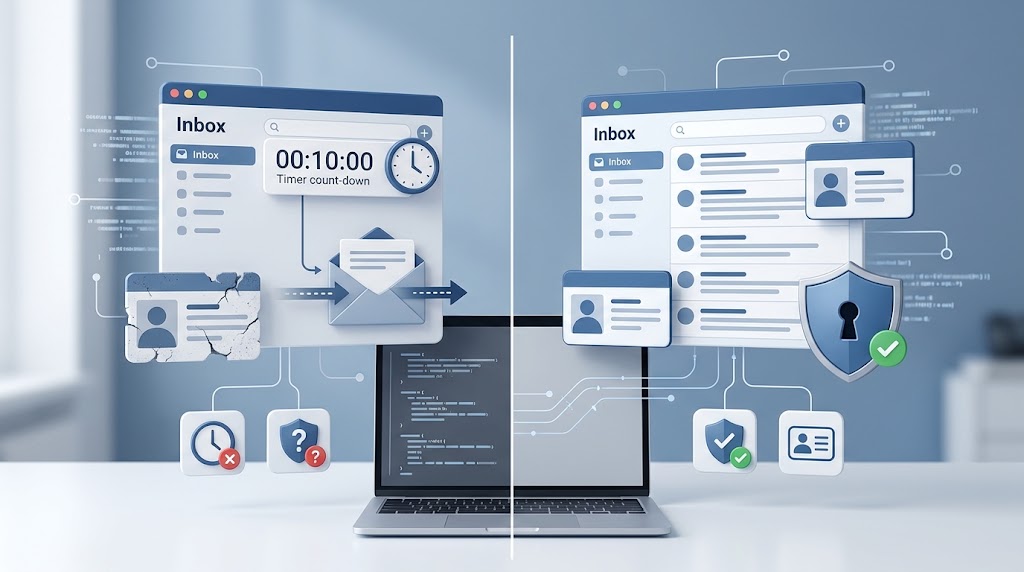
Temporary email and email aliases are frequently mentioned in the same breath, and it is easy to see why — both are ways of avoiding handing out your real, permanent email address directly. But they are built to solve different problems, and mixing them up often leads to using the wrong tool for a given situation. Understanding the actual distinction makes it much easier to pick the right one each time.
What a disposable email address actually is
A disposable, or temporary, email address is a short-lived inbox that is not connected to your real email account in any way. It is generated on the spot, functions independently for a limited window of time — typically somewhere between a few minutes and 24 hours — and then disappears entirely along with any messages it received. There is no forwarding involved and no ongoing relationship with your actual inbox. Once it expires, it is simply gone.
What an email alias actually is
An email alias is a permanent alternate address that forwards incoming mail directly into your real, existing inbox. Unlike a disposable address, an alias does not expire on its own — it continues working indefinitely, or until you manually disable it. The core function of an alias is to let you present a different address to the outside world while still reliably receiving that mail in the account you actually check every day.
Many major email providers, as well as dedicated alias services, support creating multiple aliases tied to a single real inbox. This allows you to use a different alias for different services — one for shopping, one for a specific newsletter, one for a particular app — while all of the mail ultimately lands in the same place. If a particular alias starts attracting excessive spam, it can typically be disabled individually, without needing to change your primary address.
The key difference: expiration versus forwarding
The clearest way to separate these two tools is by what happens to the mail over time. A disposable address is designed to stop functioning after a short window — that is the entire point, and it is what makes it appropriate for one-time sign-ups. An alias is designed to keep functioning indefinitely while forwarding mail into an inbox you already use, which is what makes it appropriate for accounts you want to maintain long-term while still keeping your real address somewhat shielded.
When a disposable address is the better choice
- Claiming a one-time discount code or promotional offer
- Downloading a gated resource you will only need once
- Testing a signup form or trying a free trial with no plans to continue
- Registering for a single webinar or online event
- Any interaction where you will never need the address to work again
In each of these cases, the short lifespan of a disposable address is a feature, not a limitation. You get exactly the amount of access you need and nothing more persists afterward.
When an email alias is the better choice
- Signing up for a service you intend to use regularly, like a subscription or app account
- Situations where you may need to reset a password or recover an account later
- Separating different categories of mail (shopping, work, hobbies) while keeping everything in one inbox
- Wanting to shield your real address from a company while still reliably receiving their mail long-term
- Any account where losing access permanently would be genuinely inconvenient
An alias essentially gives you the privacy benefit of not exposing your real address directly, without sacrificing the reliability of a permanent, recoverable inbox.
Can they be used together?
Yes, and many people naturally end up using both, just for different categories of sign-up. A reasonable approach is to default to a disposable address for anything short-term and low-stakes, and to use a small set of aliases for the handful of ongoing services and accounts that genuinely need long-term reliability. This combination covers most of the sign-up situations people encounter without exposing a real, primary email address any more than necessary.
A common mistake worth avoiding
The most frequent error is using a disposable address for something that actually needed to persist — a trial that turned into a real subscription, a forum account you ended up using regularly, or a purchase confirmation you needed weeks later for a return. Because a disposable address does not warn you before it expires and offers no way to recover access afterward, this mistake usually surfaces at the worst possible moment, such as needing a password reset for an account you can no longer reach.
The reverse mistake — using your real email or a permanent alias for something that was always going to be a single, disposable interaction — is far less costly, but it does contribute to the same long-term inbox clutter and expanded digital footprint that both tools are meant to help avoid in different ways.
Cost considerations
Disposable email services are almost universally free, since the underlying infrastructure required — a short-lived mailbox that is quickly discarded — is inexpensive to provide at scale. Email aliases, on the other hand, range from completely free options bundled with certain email providers to paid, dedicated alias services that offer additional features like custom domains, advanced filtering rules per alias, or the ability to create an unlimited number of aliases. Whether a paid alias service is worth it generally depends on how many separate identities you want to maintain and how much control you want over managing them individually.
How each tool handles attachments and formatted content
Because a disposable inbox is built for quick, temporary access, some providers limit how large an attachment can be or simplify how formatted HTML content is displayed. An email alias, by contrast, simply forwards mail into your regular inbox, meaning attachments and formatting behave exactly as they would with any normal email, since your usual email client is handling the final presentation rather than a specialized temporary-inbox interface.
Setting up each tool
Getting a disposable address typically requires nothing more than opening a service like VanishBox, where an address is generated automatically with no signup step of its own. Setting up an email alias usually involves going into your existing email provider's settings, or using a dedicated alias service, to generate a new forwarding address tied to your account — a slightly more deliberate setup step, but one that only needs to happen once per alias.
How each tool fits into a broader privacy routine
Neither a disposable address nor an email alias is meant to function as a complete privacy solution on its own. Both work best as part of a broader set of habits that might also include a password manager for generating unique credentials per account, two-factor authentication where it is available, and periodic reviews of which accounts and mailing lists you are still actively using. Thought of this way, disposable email and aliases are complementary tools addressing two different points along the same spectrum — short-term, throwaway interactions on one end, and long-term, semi-private relationships on the other — rather than competing options where only one is the "correct" choice.
Do aliases and disposable addresses handle spam differently once it starts?
If a disposable address starts attracting spam, the issue resolves itself automatically the moment the address expires — there is nothing further to manage. If an alias starts attracting spam, most alias services and email providers allow you to disable that specific alias individually while leaving your real inbox and any other aliases untouched, which is a meaningfully different kind of control than what a disposable address offers, since an alias gives you the option to selectively cut off one source without losing access to anything else tied to that same address.
Choosing based on how long you expect the relationship to last
If there is one single question to ask when deciding between the two, it is simply: how long do I expect this relationship to matter? An hour or a day points clearly toward a disposable address. Months or years, especially with any chance of needing account recovery, points clearly toward an alias or your real address directly. Most day-to-day sign-up decisions become considerably easier once framed this way, rather than trying to evaluate each tool's full feature set from scratch every time.
Frequently asked questions
Does an email alias hide my real address from the recipient?
In most implementations, yes — the sender only ever sees the alias, not your underlying real address, while mail is still forwarded to your actual inbox behind the scenes.
Can I reply to messages using an alias?
Many alias services support replying from the alias itself, so the recipient continues to see only the alias address rather than your real one. Disposable email inboxes typically do not support replying at all.
Which one is better for privacy overall?
Neither is universally better — they address different needs. Disposable email is stronger for one-time, low-stakes interactions, while an alias is better suited to ongoing accounts where you still want to limit direct exposure of your real address.